Intro
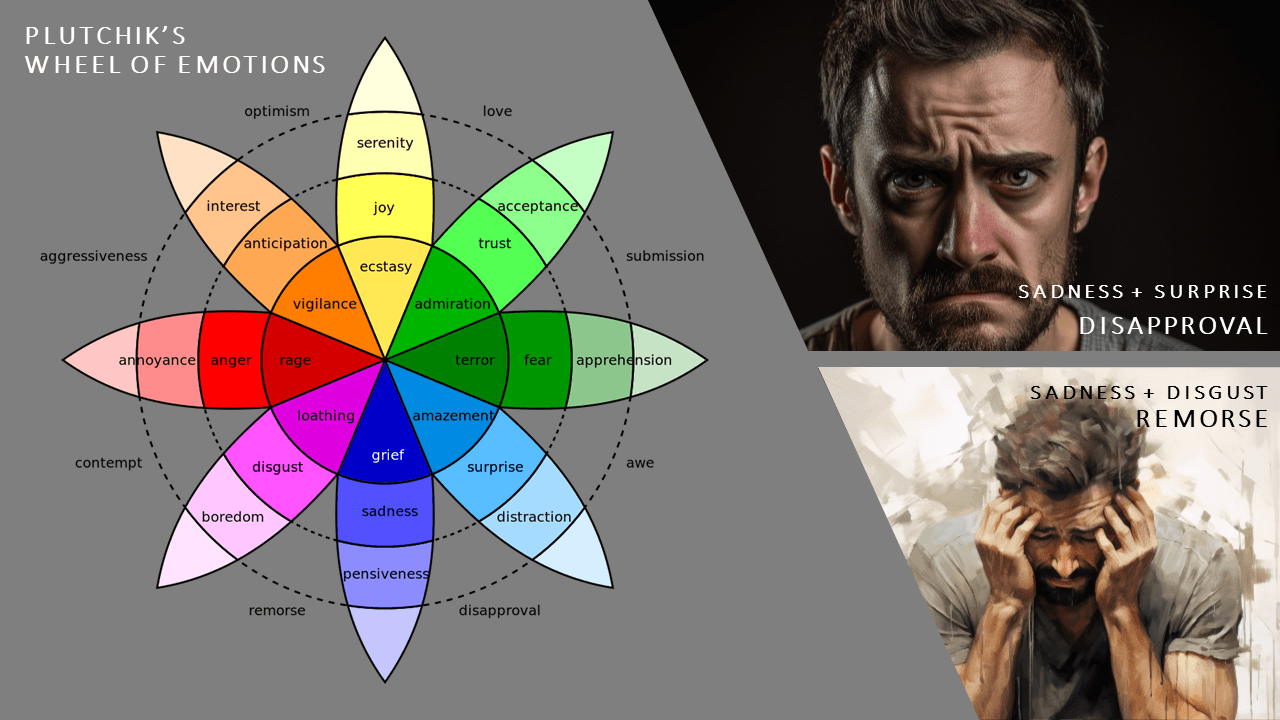
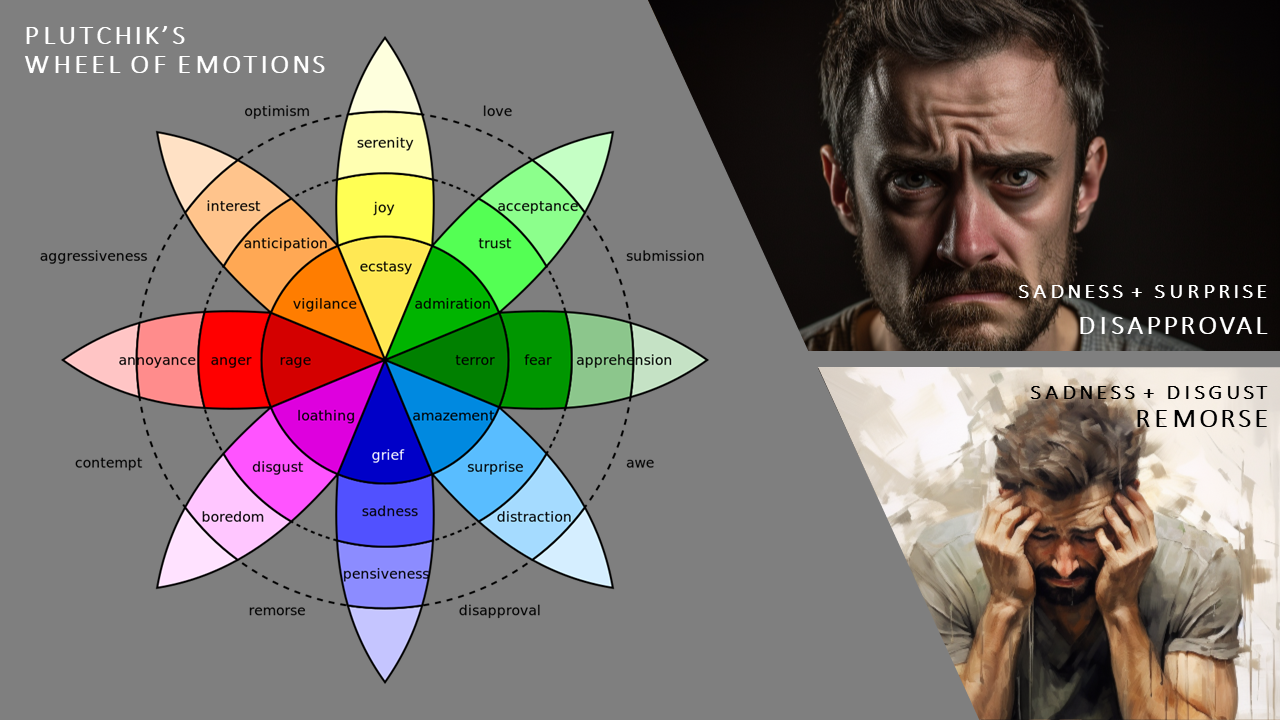
Welcome to my journey through Plutchik's Wheel of Emotions, a fascinating guide to my inner feelings. In this blog, I'm about to dive into the world of "Disapproval (Sadness + Surprise) and Remorse (Sadness + Disgust)." What makes it exciting? I'm going to explore real-life examples of both positive and not-so-positive actions tied to these emotions (using ChatGPT). It doesn't matter whether they're usually seen as good or not – emotions are complex! Before I set sail, check out my previous blog post, "Expression and Empathy: Navigating Plutchik's Wheel of Emotions - Pairs, Intensities, and Combinations," for a quick refresher on this intriguing model.
Examples of Potential Actions
Disapproval (Sadness + Surprise)
Positive Actions
| Action Name | Action Brief |
|---|
| Constructive Feedback | Expressing disapproval through constructive feedback and suggestions for improvement, fostering growth and learning. |
| Open Communication | Engaging in open and honest communication to address concerns and conflicts, promoting resolution and understanding. |
| Setting Boundaries | Establishing and communicating personal boundaries to maintain respect and boundaries within relationships and situations. |
| Encouraging Change | Encouraging positive change and growth in oneself or others when disapproval arises, promoting personal development. |
| Seeking Solutions | Actively seeking solutions and alternatives when faced with disapproval, aiming for effective problem-solving. |
Negative Actions
| Action Name | Action Brief |
|---|
| Criticism Without Solution | Providing criticism or disapproval without offering constructive solutions, potentially leading to frustration and conflict. |
| Avoidance of Communication | Avoiding open communication and conflict resolution when disapproval arises, allowing issues to persist and escalate. |
| Overly Rigid Boundaries | Setting overly rigid or unreasonable boundaries when expressing disapproval, hindering relationships and flexibility. |
| Resistance to Change | Resisting change or growth when disapproval is expressed, potentially leading to stagnation and missed opportunities. |
| Negative Confrontation | Confronting disapproval with hostility or aggression rather than constructive dialogue, escalating conflicts. |
Remorse (Sadness + Disgust)
Positive Actions
| Action Name | Action Brief |
|---|
| Taking Responsibility | Acknowledging and taking responsibility for one's actions or decisions that led to harm or wrongdoing, promoting accountability and growth. |
| Apologizing Sincerely | Offering sincere and heartfelt apologies to those affected by one's actions, showing genuine remorse and willingness to make amends. |
| Making Amends | Actively working to make amends and rectify the consequences of one's actions, seeking to repair relationships and trust. |
| Seeking Forgiveness | Humbly seeking forgiveness from others and oneself, recognizing the need for healing and reconciliation. |
| Self-Reflection | Engaging in deep self-reflection to understand the root causes of one's actions, aiming for personal growth and positive change. |
Negative Actions
| Action Name | Action Brief |
|---|
| Defensiveness | Responding with defensiveness or denial when confronted with the consequences of one's actions, hindering resolution. |
| Minimizing Harm | Minimizing or downplaying the harm caused by one's actions, which can be perceived as insensitivity and lack of remorse. |
| Blaming Others | Shifting blame onto others or external factors instead of taking personal responsibility, impeding self-awareness and growth. |
| Ignoring Consequences | Ignoring or avoiding the consequences of one's actions, leading to continued harm and unresolved issues. |
| Lack of Empathy | Demonstrating a lack of empathy or understanding for the pain or suffering caused by one's actions, straining relationships. |
Diverse avenues of exploring emotions
In this small attempt to provide examples of actions, we've explored how positive and negative feelings can lead to corresponding actions. However, emotions are multifaceted, and there are numerous ways to understand them. Beyond actions, alternative methods such as mindfulness, creative expression, journaling, open conversations, literature and film, self-assessment tools, cultural context, psychological research, literary analysis, nature's impact, and dream analysis offer diver